

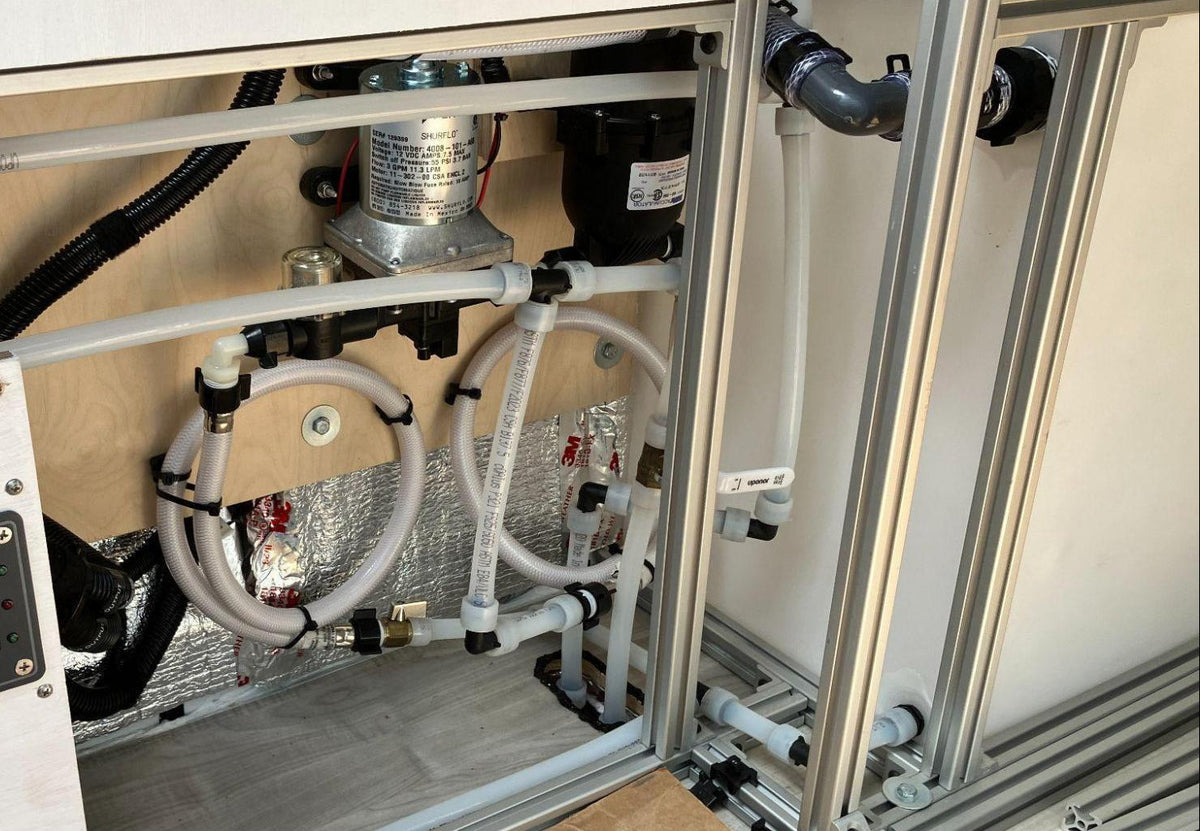
Plumbing is fun. Plumbing is fun. Plumbing is fun. That’s what I tell myself to get psyched up for a plumbing project. Because plumbing isn’t fun?!
The reality is that plumbing is not so bad if you have a plan. This post helps a DIYer plan by showing an example of how I completed my fresh water plumbing system using PEX-A (also known as expansion PEX).
This post starts with a little Plumbing 101 and details the major items in my plumbing system. I compare the differences in PEX-A vs PEX-B. I talk about how to approach van conversion plumbing by starting with the fresh water tank. And of course there is a free example plumbing diagram and list of all of the part numbers used in this fresh water van system too. Fun!
Camper Van Plumbing System Overview
Most van conversion plumbing systems include a tank, water pump, accumulator, and faucet. I’m on Team Hot Water, meaning my fresh water systems have a water heater. Every plumbing system needs to be designed to be filled (add an inlet), drained (add an outlet valve), and maintained (add shutoff valves). Other nice-to-haves may include additional indoor/outdoor showers, water filtration, or even multiple tanks to expand capacity.
- Water tanks provide the water storage reservoir for your plumbing system. Tanks are available in different sizes and layouts, including for undermount beneath your rig or for interior mounting, with wheel-wheel designs being very popular for their efficient use of space. Size matters for water tanks, but bigger isn’t always better. Bigger tanks mean more weight and more space, making a tradeoff where something else may not fit. Individual preference will vary between water usage and van size, but tanks in the 25-30 gallon range may be the sweet spot for many customers.
- A water pump is required to create pressure allowing water to flow through a water heater and to faucets or showers.
- An accumulator, or more accurately a pressure accumulator tank, is an optional but highly recommended device for your water system that helps reduce water pump cycling, stabilizing your water system pressure and reducing wear & tear on the water pump.
- A water heater takes cold fresh water through a tank and a heating element to provide hot water. We’re big fans of using Isotemp water heaters to get free hot water from the van’s engine coolant.
- Sink faucets and shower valves probably don’t need any explanation. That’s where the water is supposed to come out of your plumbing system.
This all-electric (no propane) example plumbing system helps you understand how to design your own fresh water system using PEX-A. Want to know more about gray tank plumbing systems? Check out our blogs on camper van drains as well as an alternative take on fresh and gray water plumbing.
Camper Van Plumbing Diagram
Click to download a PDF of the example plumbing diagram.

The diagram shows an example fresh water van plumbing system using PEX-A. Fittings and piping for each plumbing component are noted in the diagram, and identifying the fittings for your plumbing system is an important step as discussed in Understanding Fittings below.
PEX-A vs PEX-B: Which is Better for Van Plumbing?
PEX-A is one option for piping a van conversion fresh water plumbing system. PEX-B, vinyl tubing, or other options all have their tradeoffs.
PEX-A is also known as Expansion PEX. One name brand PEX-A is Uponor/Wirsbo ProPEX (not to be confused with Propex, LPG/propane!). This post and example diagram provides name brand part numbers because skimping on quality may lead to seriously un-fun leaks.
PEX-A and PEX-B are two of the most popular piping selections for camper van plumbing. PEX-A is slightly more expensive than PEX-B. However, PEX-A does have many advantages over PEX-B:
- Higher water flow rates due to less constriction from fitting design
- Better freeze-expansion resiliency
- More flexible routing and less prone to kinking
PEX-A requires an “expander tool” to make each connection from fitting to piping. Unlike PEX-B, PEX-A does not require a Go/No-go Gauge to check every connection. A PEX-A connection example is shown in the following four pictures.
 2) Insert the ring over the piping, then use the expander tool
3) Rotate the ring with piping, insert the expander tool further, and complete the expansion
4) Insert the expanded ring with piping fully on to the fitting, then allow the ring & piping to contract
The two main gripes against PEX-A compared to PEX-B are that PEX-A is a little more expensive and that PEX-A requires a small wait time for the expanded ring with piping to contract (which completes the leak-free fitting). I think that freeze resiliency, water flow rate, and more flexible piping (which allows less fittings & couplings) justifies the slight cost increase for PEX-A. And waiting a few extra minutes to apply pressurized water to the completed plumbing system? Take a second to pat yourself on the back for a plumbing system well done, or go work on another build project for a few minutes. I don’t see a small wait time as an issue for a van build. Also, with PEX-A you don’t have to hunt for the Go/No-go Gauge to check every connection.
I’ll fully admit that I had one PEX-A connection in my plumbing system that leaked like a sieve. It turns out that the ring with stop is an important part of an expansion PEX connection! I expanded the piping without the ring and installed that over a fitting. Oops! Lesson learned. Don’t do that.
Key Parts in This Camper Van Water System
Water tanks provide the water storage reservoir for your plumbing system. Most camper van water tanks are designed for unpressurized systems. Unpressurized means that the tank should not be filled by pressurized water, such as a directly attached garden hose from a city water spigot. These tanks are “gravity fill” and require an air vent such that air escapes the tank when water is added.
Look at the heavy dashed line in the example plumbing diagram, where the water tank and everything before the water pump inlet operates as an unpressurized system. Because the “gravity drain” is unpressurized, and because this system only has ½” piping for that drain, emptying a full water tank using the gravity drain spigot is SLOW. More on that later in Maintenance, Draining, and Winterization Tips.
A water pump pulls water from the water tank and creates a pressurized portion of the water system. To maximize the available fresh water, a water pump should pull from an outlet near the bottom of the water tank. It’s also advisable to use a strainer at the inlet port of the water pump. The SeaFlo 42-series water pump in our store includes a strainer. A fresh water system needs a pressurized portion, just like a household plumbing system, so that water is forced out by the pump when faucets or valves are opened.
The example plumbing diagram shows two optional pieces that are recommended for a better-performing system: 1) an accumulator and 2) a pump “silencing kit”.
An accumulator tank is a small device that uses an air bladder to smooth out water flow from the pump, reducing pump cycling and improving water pump lifespan. Most diagrams show the accumulator mounted inline immediately at the output of the water pump. However, an accumulator can be added anywhere to the pressurized (cold) water system to be effective, including as a “stub” with one port of the accumulator capped off. This makes it easy to add an accumulator to an existing water system.
The pump silencing kit keeps your system quieter by minimizing vibration from the water pump. The flexible hoses help prevent pump vibration from traveling into your piping throughout the rig. Off-the-shelf silencing kits are available, as shown in the example plumbing diagram, but this can also be accomplished DIY by adding a few PEX-to-barb fittings and sections of flexible vinyl piping.
A water heater has an inlet for pressurized cold water and an outlet for pressurized hot water. We talk a lot about Isotemp water heaters, including an install post and how to use our installation kit to connect the water heater to your van’s coolant system. Our Isotemp post intentionally doesn’t talk much about the water plumbing, because every rig is different. Well, this post and example plumbing diagram fills in that blank and shows you one way to connect an Isotemp into your van conversion water system.
Aside from tapping into your van’s coolant system for free hot water, Isotemp water heaters have several other useful features for a camper van water system. The water heaters do have an AC powered heating element as a backup if you’re not running the engine or have access to shore power. The water heaters produce hot water, typically well above 150 degrees Fahrenheit, so Isotemp includes a mixing valve at the outlet so that you can set your plumbing system’s hot water to a non-scalding temperature, typically 100-120 degrees Fahrenheit. Because the hot water stored in the tank is mixed with cold water at the outlet, your effective hot water capacity is more than just the water stored in the heater.
Isotemp water heaters include a safety/relief valve that doubles as a drain valve. This valve is located at the (cold) fresh water inlet to the water tank, but when the valve is opened both cold and hot water can be drained from your system. Do not cap the drain valve, as the tank may need to weep water from expansion during heating. This means that the drain valve should be plumbed, and Isotemp recommends a clamped vinyl tube for that purpose.
Understanding Fittings
Fittings are probably where plumbing becomes not fun for most people. To make plumbing simple, you need to know the gazintas and gazoutas of each plumbing component. Using a water tank as an example, the inlet (gazinta) is typically a 1-½” NPT female, while the outlet (gazouta) is typically a ½” NPT female in van plumbing systems. If you know what fitting the component has, then you know what “mate” your plumbing needs for each connection. In that example, a ½” NPT female needs a ½” NPT male to complete the connection.
The plumbing trade still commonly uses female and male to describe the mating sides. The industry is slowly moving towards socket and plug to be more inclusive. This post uses the most common terminology to avoid confusion.
But what do all these terms mean? Fittings are specified with the connection type, the mating side, and the size.
Connection Type
Common camper van plumbing fittings are NPT, NPS, barb and PEX.
- NPT, or National Pipe Tapered, is a standard for a threaded fitting. The threads narrow (taper) which allows a seal to be formed during connection. NPT fittings require Teflon (PTFE) tape or pipe dope during installation.
- NPS, or National Pipe Straight, is a common definition for non-tapered (straight) threaded fittings. Because there is no taper to force a seal, NPS fittings rely on a gasket or O-ring to prevent leaks.
- Barb fittings are intended for flexible piping, such as vinyl tubing. These fittings have ridges (barbs) that contact the piping to create a seal. Barb fittings are typically secured with clamps. Spring clamps are ideal because they provide equal pressure around the barbs, although standard (cheaper) worm-gear hose clamps can suffice.
- PEX fittings are intended for PEX piping. Very similar to barb, PEX-A uses contraction of the piping (while PEX-B uses a clamp or crimp ring) to secure the connection.
Many, but not all, van plumbing component fittings are NPT. Water tanks, water pumps, accumulators, water heaters, and even some faucets are typically NPT. The example plumbing diagram shows a few examples of other fittings, including barbed fittings for the water tank gravity fill & vent connections and NPS fittings for the outdoor shower. If you use a household faucet for your galley sink, that may require another type such as ⅜” compression fittings.
Mating Side
The mating side of a fitting is typically female (socket) or male (plug). Many fittings combine the connection type (eg. NPT, NPS) and the mating side into a single acronym. The example plumbing diagram has a legend for these acronyms:
- FPT = female NPT
- MPT = male NPT
- NPSF = NPS female
- NPSM = NPS male
Many in the trade refer to a fitting using just the size and acronym, ½” FPT for example.
Why are the connections and mating sides inconsistent from acronym to acronym? Ask a plumber!
Size
Size is another source of confusion in fittings, because the size value varies with connection type. What? NPT fittings refer to the inner diameter (ID, the hole inside the fitting). NPS fittings specify neither the inner diameter nor the outer diameter, because the thickness of the pipe changes the resulting inner hole size. Barb fittings refer to the inner diameter of the piping that’s attached to the barb. PEX, like NPS, refers to neither the inner nor outer diameter size. Here’s my recommendation, don’t try and measure a fitting to determine its size. Check out the manufacturer information that tells you what fittings are required, or in rare cases when that’s not available for our products, contact us.
Common van plumbing sizes are ½” and 1-½” (as in one and a half, 1.5”) for fresh water. ½” plumbing for the pressurized water system is sufficient for most camper vans. Some opt for ¾” plumbing in larger rigs or for more water flow. Drains vary depending on included fittings and desired flow rates, although 1-¼”, 1-½”, and 3” are common sizes.
Selecting a Fitting
Once you know the fitting you have on your plumbing component, you need to know what’s being connected on the other side. In most cases, the other side is your plumbing piping, ½” PEX-A in the example plumbing diagram and parts list. Selecting a fitting means knowing the connection type, the mating side, and the size for both sides of the fitting. Going back to the water tank outlet example, one side of the fitting needs to be ½” NPT male, and the other side of the fitting wants to be ½” PEX-A. In the example plumbing diagram, that fitting is a Uponor (Wirsbo) Q4625050. Uponor (Wirsbo) is the manufacturer, a name brand in the plumbing industry. Uponor officially titles that part number a ProPEX EP Male Threaded Adapter, 1/2" PEX x 1/2" NPT. The “EP” is new information in that product name, and that’s Engineered Polymer. More on that in a bit.
For your fresh water system, make sure that you’re selecting drinking water safe components, fittings, and piping. The water tanks, pumps, and faucets in our store are drinking water safe. PEX, some vinyl tubing, and most polymer fittings are drinking water safe. For metal fittings, look for labels including “potable water”, “zero lead” or “lead free” stainless steel or DZR brass, and compliant with the Safe Drinking Water Act.
Engineered Polymer (aka plastic) fittings are more resilient to freeze damage than metal fittings because the material tolerates expansion & contraction better than metal. Plastic fittings are also lighter and cheaper than metal fittings. PEX piping can connect easily to metal or plastic fittings, and valves are typically metal. Sometimes (like the ½” FPT to PEX fitting in our example plumbing diagram) it can be difficult to source plastic fittings. Caution is needed when mixing plastic and metal fittings, particularly with NPT, so the rule of thumb is to use male plastic fittings with female metal fittings…never the opposite.
How to Plan Your Van Plumbing
I recommend starting at the water tank when planning your fresh water plumbing system. For each plumbing connection, follow these steps:
- Identify the connection type, mating side, and size. Example: Water tank outlet is ½” FPT, so a ½” MPT fitting will be required.
- Identify the piping or next connection. Example: ½” PEX-A piping.
- Determine the appropriate fitting for the connection. Example: Uponor Q4625050 1/2" ProPEX EP Male Adapter.
- Run the piping to the next component.
- Repeat Steps 1-4 for each plumbing component.
Don’t forget to think ahead about where to add shutoffs and drains for maintenance.
Parts and Tools List
Big box stores carry many of the pipings and fittings shown in the free example plumbing diagram. I prefer a dedicated plumbing store, and I’ve had good luck using supplyhouse.com. Use their Live Chat if you need help finding the right fitting, and they have great customer service and ship quickly (like us!).
Here is a list of the piping and fittings in this fresh water plumbing system.
|
Item |
Manufacturer and Part Number |
Purpose |
|
½” MPT to ½” barb adapter |
Spears 1436-005 |
Water tank vent fitting |
|
½” ID vinyl tubing (10’) |
Everbilt T10006010 |
Water tank vent line |
|
½” hose clamp |
Everbilt 6760595 |
Water tank vent line clamps |
|
1-½” MPT to 1-¼” barb adapter |
Spears 1436-212 |
Water tank fill fitting |
|
1-¼” ID vinyl tubing (25’) |
Everbilt HKP001-PVC018 |
Water tank fill line |
|
1-¼” hose clamp |
Everbilt 6720595 |
Water tank fill line clamps |
|
½” PEX-A piping (100’) |
Uponor (Wirsbo) F1040500 |
Expansion PEX tubing |
|
½” PEX Ring With Stop |
Uponor (Wirsbo) Q4690512 |
Every expansion PEX connection |
|
¾” MHT to ½” PEX sillcock |
Webstone 33202WSSL |
Drain valve |
|
½” PEX tee |
Uponor (Wirsbo) Q4755050 |
All three-way PEX tubing connections |
|
½” MPT to ½” PEX adapter |
Uponor (Wirsbo) Q4625050 |
Water tank outlet |
|
½” MPT to ½” PEX ball valve |
Uponor (Wirsbo) LF4795050 |
Maintenance shutoff |
|
½” FPT to ½” PEX adapter |
Uponor (Wirsbo) LF4575050 |
Accumulator |
|
½” PEX ball valve |
Uponor (Wirsbo) LFR4815050 |
Maintenance shutoff |
|
½” NPSM (swivel faucet) to ½” PEX adapter |
Uponor (Wirsbo) Q4360500 |
Outdoor shower |
|
½” PEX 90 elbow |
Uponor (Wirsbo) Q4760500 |
Any right-angle PEX tubing connection |
|
½” PEX coupling |
Uponor (Wirsbo) Q4775050 |
Join two pieces of PEX tubing |
|
½” PEX plug |
Uponor (Wirsbo) Q4350500 |
Cap a piece of PEX tubing |
I used these tools to properly build a PEX-A system for my camper van.
|
Tool |
Purpose |
|
Required for making PEX-A connections |
|
|
Helpful to make straight piping cuts |
|
|
Required for NPT fittings (or use pipe dope) |
The following plumbing components are shown in the example plumbing diagram.
|
Component |
Manufacturer and Part Number |
|
Fresh water tank |
|
|
Gravity fill |
Valterra A01-2003BU |
|
Water pump |
|
|
Accumulator |
|
|
Pump silencing kit |
Valterra P23512PB |
|
Water heater |
|
|
Sink with faucet |
|
|
Outdoor shower |
Dura Faucet DF-SA189 |
Maintenance, Draining, and Winterization Tips
A van water system should be designed for easy maintenance. You want to be able to completely drain your water tank and piping for winterization or for periods when your van plumbing system is not in use. Be mindful of low spots where water can not fully drain from the piping, and add drain valves at those low locations.
Shutoff valves should be added too. The example plumbing diagram shows a shutoff to disable the pressurized water system for water pump repairs, including regular inspection & cleaning of the strainer. A shutoff is also included to turn off the hot water system for tank inspection or repair.
I strongly recommend adding an inspection hatch to your fresh water tank. An inspection hatch helps you mop up all remaining water in the bottom of the tank and clean the interior during maintenance. No water tank drain is perfect, so there is always some water remaining inside the bottom of your tank after draining. An inspection hatch also allows you to inspect a float-type water level sensor if you don’t opt for SeeLevel no drill tank monitoring system.
This example van conversion fresh water plumbing system shows a ½” gravity drain to a garden hose spigot. The gravity drain is labeled “slow” for a reason…it takes a long time to drain a large water tank using ½” piping. Draining can be sped up using 1-½” piping to a dedicated drain through the van’s floor. In my case, the water heater is mounted so that the relief/drain valve is the lowest point of my water system. I leave the water pump on and manually open the Isotemp drain valve to rapidly empty my water system. Using this method, the cold water and hot water in the system can be drained rapidly. Still, the gravity drain is an important fallback that does not require power to operate, and after turning off the water pump any remaining water can be drained through the spigot.
Frequently Asked Questions
Can you use PEX plumbing in a camper van?
Absolutely. PEX plumbing is flexible, easy for DIYers to install with minimal tools, cost-effective, resilient to freezing temperatures, and drinking water safe.
PEX-A vs PEX-B: Which is Better for Van Plumbing?
Both PEX-A (expansion PEX) and PEX-B are well-suited for camper van conversion plumbing systems. PEX-A is more flexible & resists kinking and has higher flow rates, while PEX-B is slightly more affordable.
Do I need an accumulator in my camper van water system?
No, but an accumulator is highly recommended. An accumulator is optional, but the pressure accumulator tank smooths out water flow, reducing pump cycling and improving water pump lifespan.
What does gravity fill mean on a camper van water tank?
Gravity fill is the standard method for filling camper van water tanks, and using a pressurized city water connection could cause a water tank to burst. Water flows into a tank using gravity and a vent to allow air to escape the tank.
How do you winterize a camper van plumbing system?
The recommended method to winterize a van conversion water system is to completely remove all water from the tanks and piping. Install drain valves at key (the lowest) locations in your plumbing that may trap water. Low pressure air can be used to help flush water through the piping, but use caution and don’t overpressurize the components. Using antifreeze is possible but not necessary for a well-designed water system.
Do I need thread tape on fittings?
NPT fittings require Teflon (PTFE) thread tape or pipe dope for lubrication and sealing. Apply tape to a male NPT fitting prior to assembly. NPS fittings rely on a gasket or O-ring to create a seal, and NPS fittings do not require tape. PEX and barb fittings rely on compression, so do not apply tape to those fittings.
What is the difference between NPT and NPS fittings?
NPT and NPS are both common plumbing fittings. NPT stands for National Pipe Tapered, and NPS stands for National Pipe Straight. NPT and NPS are not compatible, so select the appropriate mating type for each fitting.


