

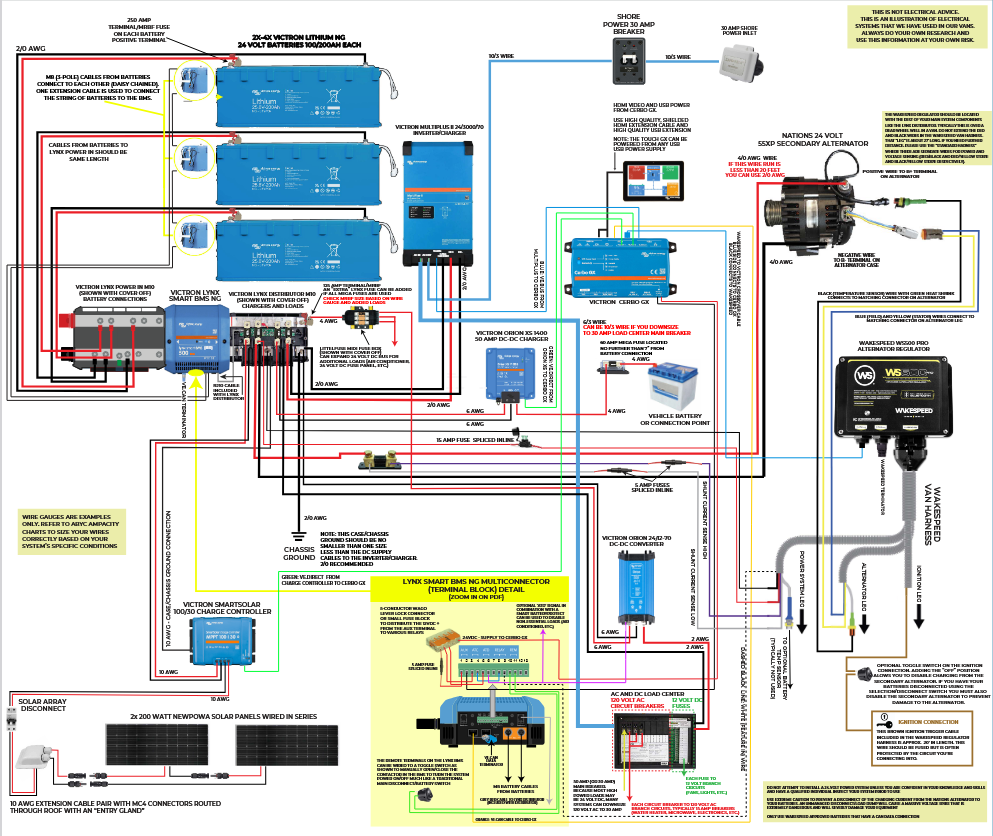
Example 24V Camper Van Electrical System with Victron NG Batteries and Secondary Alternator
Options.
Voltage. Capacity. Charging methods. Brand. Topology. Are there too many options for your camper van electrical system? If your answer is Yes, then we’re here and happy to help. Reach out to us, and our goal is to help you understand more about our camper van electrical system bundles (or any product in our store!). We pride ourselves on actually responding to your emails or picking up your phone call. We may even be working from our vans while we’re doing it!
Whether your answer above was Yes or No, this blog post is a reminder that you do have options. In particular, we’ve added to our suite of free example wiring diagrams to include a complete 24 Volt electrical system based on Victron NG batteries that can be paired with a high-power secondary alternator for charging.
12 Volt, 24 Volt, or 48 Volt? Shore power, DC-DC (primary alternator), secondary alternator, and/or solar charging? Yep, you can do that.
Let’s talk about this 24 Volt Victron NG-based electrical system
Options does not have to mean Complication. In fact, this 24 Volt NG electrical system for your camper van has CAN ( “controller area network“) communication so that you don’t need to fiddle with every device configuration to get the system working well – all of the major system components “talk” to each other and communicate with the batteries for safe, reliable and fast charging or discharging. In Victron-speak, these devices are Smart.
This bundle can include a ~3,600 Watt (150 Amp) Nations secondary alternator plus an additional 700 W (or more) of DC-DC charging from the primary alternator. That’s a lot of charging power while driving. Sure, adding a little bit of solar charging can help keep up with those house loads too. As far as discharging, a Multiplus “3000” is still probably in the sweet spot, capable of surging up to 5500 Watts of AC load.
What’s different with this system? Not a lot really. In the example wiring diagram, you’ll see many similarities to our 12 Volt and 48 Volt secondary alternator system bundles. Of course we’ve carefully selected 24 Volt equipment in this case. And there’s still some 12 Volts running around as discussed in this blog. If you’re considering a 24 Volt system, we expect that you’re selecting as many 24 Volt appliances as possible, but it’s hard to completely remove 12 Volts. Air conditioner, refrigerator, air heater, lighting, pumps,… the list goes on, and yep, you can do that at 24 Volts.
The number of 24 Volt loads may turn out to be one of the more annoying issues to handle in this system. And it’s not that bad. You can easily expand the 24 Volt distribution with a second Lynx Distributor, but the distributor uses MEGA fuses that only go down to 40 Amps. The example wiring diagram shows a Littelfuse MIDI Fuse Holder that can provide an extra 2 or 3 loads with MIDI fuses that go down to 30 Amps. Rather than inline fuses for the multitude of smaller load branches at 24 Volts, it may make sense to use a DC fuse block wired from the Lynx Distributor. Many sizes of DC fuse blocks are offered by Blue Sea, including this one with six circuits.
The primary non-Smart device shown in this system is the venerable Orion 24/12-70 DC-DC converter to supply that aforementioned 12 Volts. It’s possible to use the newer Smart Orion XS 1400 as the 24/12 converter instead. Using the XS 1400 gives you more visibility into your 12 V load consumption, and it provides the voltage conversion at a higher efficiency (maximum of 98.5% efficient versus 92%). Efficiency is the name of the game for a 24 Volt system, so for some customers the XS 1400 as the 24/12 converter can make sense.
In the example wiring diagram, you’ll also find a small reminder that the Lynx Smart BMS NG provides an Allow To Discharge (ATD) signal. ATD can be used to stop devices from discharging the batteries, extending the “smart” operation of your system and protecting your batteries. We show a simple wiring example where the Orion 24/12-70 DC-DC converter is enabled/disabled by ATD, and that technique can be expanded using a Smart BatteryProtect. Here’s a hypothetical use for a Smart BatteryProtect: maybe you don’t want your high-power 24 Volt air conditioner to run your batteries flat overnight while you’re boondocking. Waking up with no power available is so much fun!
How many times have I said System in this blog?
Not enough, apparently. The key part of safe, reliable and fast charging is that your electrical components have been carefully selected and proven to be interoperable. Particularly in the case of the Nations secondary alternator with Wakespeed WS500 Pro regulator as a charging option, your electrical system should include batteries officially supported by Wakespeed to work correctly and safely. The Victron NG BMS & batteries, Wakespeed regulator, and Cerbo running DVCC (along with all those other Smart devices) perform as a system that has been tested, can be supported, and is proven to operate to meet your camper van’s demands.
Wiring diagram and bundle
Click below for the 24 Volt electrical system with secondary alternator kit free example wiring diagram. This system can be purchased through our build your own bundle page. You’ll get our best bundle pricing and fast & free shipping, and of course you’ll get the electrical system best tailored to the needs of your van.
If you have questions about this 24 Volt camper van electrical system, reach out to us and someone from our tech support team will be happy to assist you.
Follow this link to gain access to our library of FREE Camper Van Electrical System Wiring Diagrams. Use the PDF files to print/zoom in.
Summary: 24V Camper Van Electrical System with Secondary Alternator Kit at a Glance
A 24 Volt camper van electrical system with a secondary alternator is one of the most reliable ways to power high-demand, off-grid living. By reducing current and wire size, 24 Volt systems improve efficiency and make it easier to run heavy loads like air conditioning and refrigerators. Many DIY camper van builders still rely on 12 Volts for lights, fans, and pumps, but adding a 24 Volt alternator setup gives you faster charging and greater flexibility. If you’re planning a complete camper van electrical system, consider whether 24 Volt is the right balance of simplicity, performance, and long-term reliability.
FAQ: 24V Camper Van Electrical Systems
Is 24V better than 12V for a camper van electrical system?
A 24 Volt camper van electrical system is more efficient for high-power setups. Because the voltage is higher, the current is lower — which means smaller wires, less energy loss, and better efficiency. A 12 Volt system is often enough for simple camper van electrical systems, but if you want to run appliances like air conditioning or refrigerators off-grid, 24 Volts is usually the smarter choice.
Do I need a secondary alternator for my camper van electrical system?
Not every van needs one. A secondary alternator kit is ideal if you drive or idle often and want reliable, high-output charging for a large battery bank. For smaller or simpler camper van electrical systems, a DC-DC charger connected to your stock alternator may be enough. In fact, both a secondary alternator and a DC-DC charger can be combined for massive charging power!
Can I mix 12V and 24V in the same camper van electrical system?
Yes — many builders do. A common setup is to use 24 Volts for high-draw loads (like heavy appliances such as air conditioners and refrigerators) and keep a small 12 Volt distribution panel for lights, fans, and pumps. This adds a little bit of complexity, but it’s a practical solution when you want the efficiency of 24 Volt and the necessity of 12 Volts.
How much does a complete camper van electrical system cost?
Costs vary depending on power needs. A simple setup might run $1,500–$3,000. A complete camper van electrical system with a large lithium battery bank, secondary alternator kit, and a 3,000W inverter/charger can cost $10k+.


